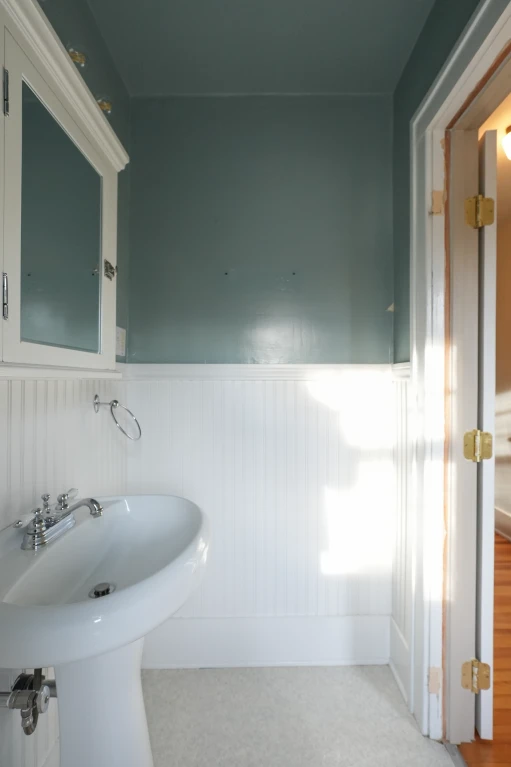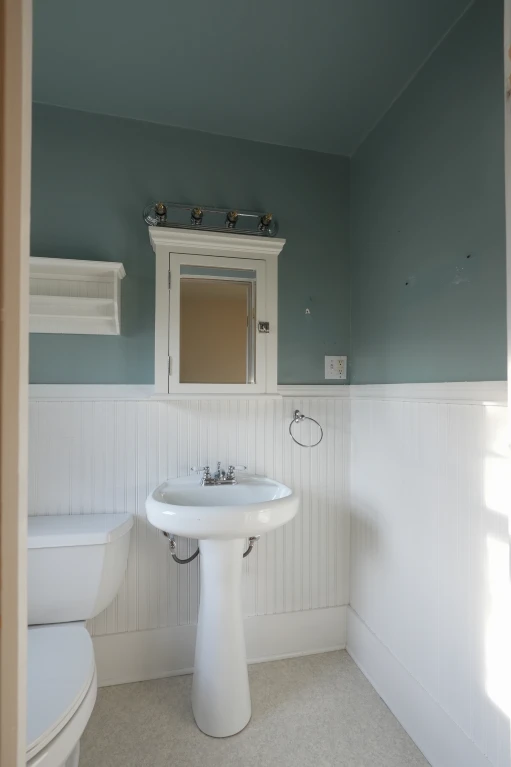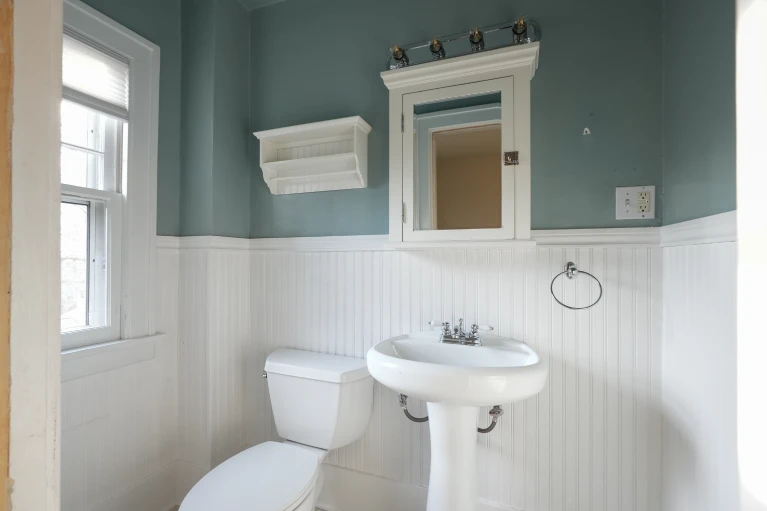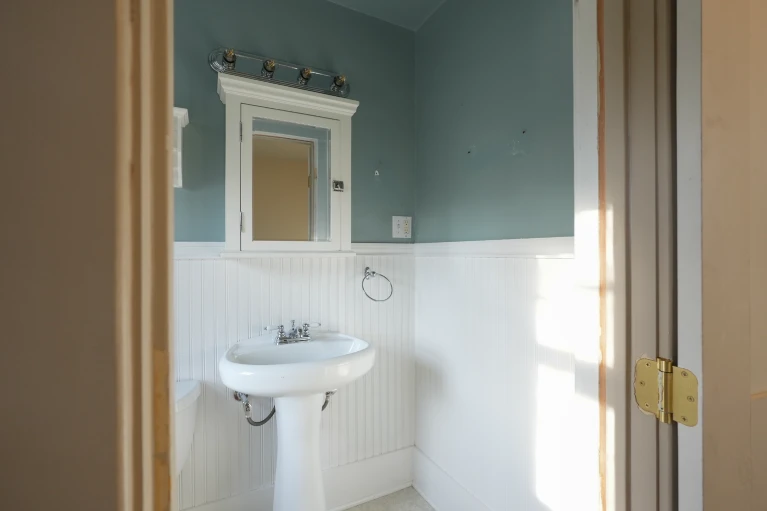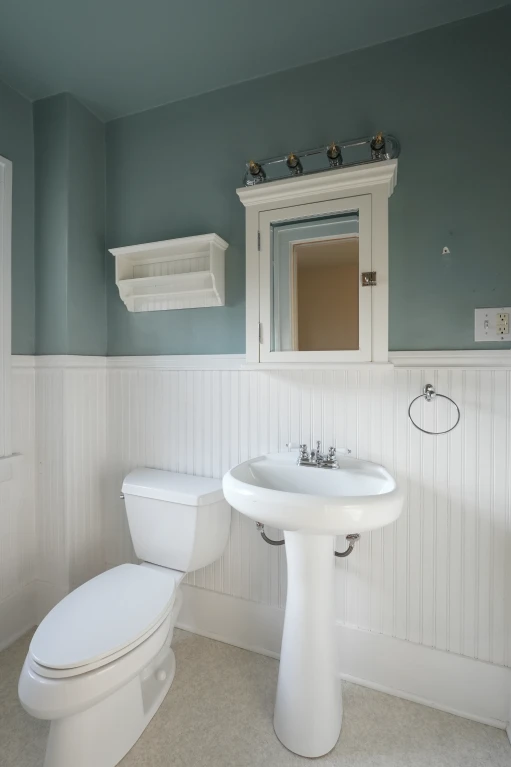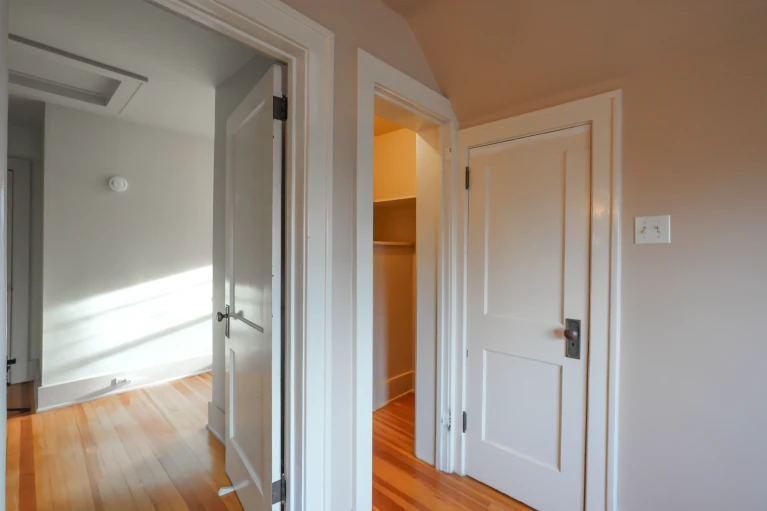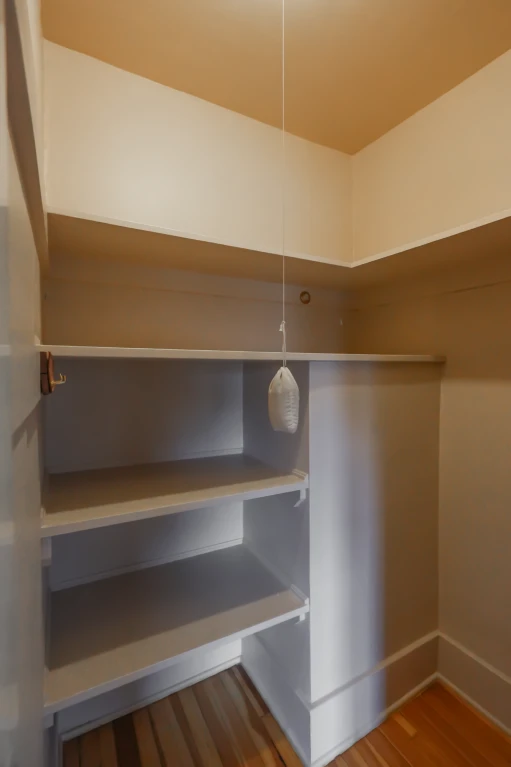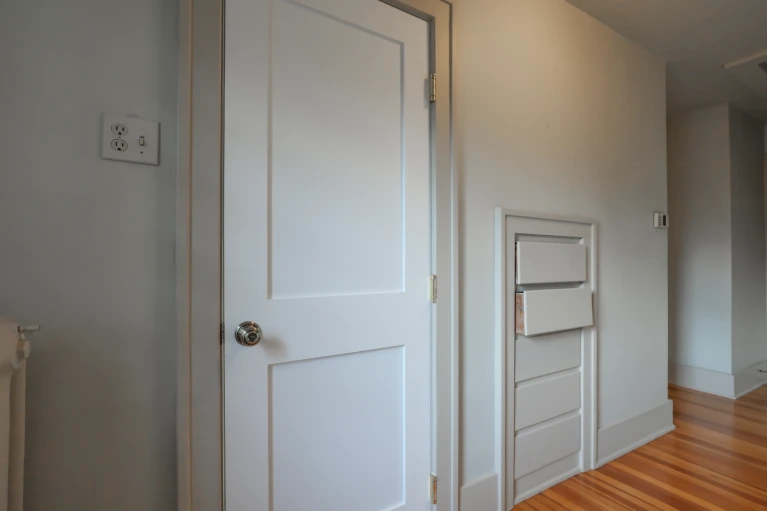
Neighborhood: West Highland | Completed: June 2026 | Scope: Powder room and closet converted into a full bathroom with walk-in shower
The homeowners at 2990 N Raleigh had a working powder room, a hallway closet pulling double-duty as overflow storage, and only one full bathroom in the house.
What they wanted was a true second full bath — with a shower of its own, not just a sink and toilet — built into the space they already had.
What they got was a new full bath with a walk-in shower, vanity, sink, and toilet — built into the same small space, without adding a single square foot to the home’s footprint.
The new bathroom was created by merging the original half bath with the adjacent closet, then re-framing the interior to support a walk-in shower stall, a Kohler pedestal-style vanity, and a relocated toilet.
West Highland is one of Denver’s oldest neighborhoods, with most original homes built between 1893 and 1939.
Bathroom conversions here are part design, part forensics.
Galvanized supply lines have to come out, stud bays rarely follow modern dimensions, and every plumbing run has to thread through framing that wasn’t designed for a second bathroom.
The Verified Builders team approaches these projects one wall section at a time — confirming what’s behind the lath, identifying what can stay, and rerouting everything that can’t.
For a household sharing a single full bath, adding a second one is rarely about square footage. It’s about solving the morning rush.
Adding or relocating plumbing fixtures in Denver requires a building permit per the City and County of Denver’s bathroom remodel project guide, and this project pulled mechanical, plumbing, and electrical permits before demo began.
Many homeowners weighing a similar bathroom conversion find that the cost to add a bathroom in Denver varies heavily depending on whether you’re tying into existing rough-in or running new lines from scratch — this one leaned toward the latter because of the galvanized replacement.
| Detail | Specification |
|---|---|
| Project Type | Powder room to full bath conversion |
| Location | 2990 N Raleigh St, Denver, CO 80212 |
| Neighborhood | West Highland |
| Completed | June 2026 |
| Scope | Combined the existing powder room with the adjacent closet to create a full bathroom with walk-in shower, vanity, sink, and toilet |
| Framing | 2"x6" stud walls; fire blocking in all vertical cavities |
| Insulation | R-21 batt in exterior-adjacent walls |
| Tile Backers | DensShield (vanity wall); GoBoard (shower enclosure) |
| Shower Waterproofing | Schluter KERDI membrane (shower floor); RedGard liquid membrane (shower walls) |
| Heated Floor | Schluter DITRA-HEAT electric radiant system under tile |
| Tile (The Tile Shop) | Basketweave Matte White with Black porcelain mosaic (floor); 2"x10" Forest porcelain stacked vertically (shower walls); 12"x24" Naturalz Matte Ash porcelain (shower pan); 2"x10" Milk porcelain stacked vertically (bathroom wainscot) |
| Plumbing | Galvanized waterlines replaced with PEX; 2" PVC drains (shower, vanity); 3" PVC toilet branch |
| Ventilation | Panasonic ducted ceiling exhaust fan, hard-vented to roof |
| Lighting | Two Kohler Purist 1 brass wall sconces; one recessed ceiling can light |
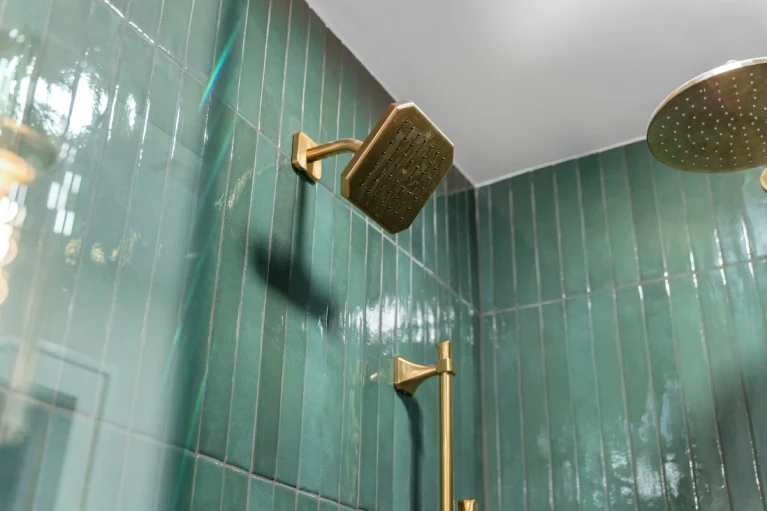
| Fixtures | Kohler Purist widespread faucet (brass); Delta brass shower system with rainhead, handheld on slide bar, and wall-mounted showerhead; Kohler toilet |
| Paint | Sherwin-Williams Pure White, eggshell sheen |
| Permits Pulled | Building, plumbing, electrical, mechanical |
Scope of Work
The build followed a standard rough-to-finish sequence: demo and framing, mechanical rough-in, insulation, drywall, waterproofing, tile, then fixtures and finish.
Demolition & Framing
Demo started with the powder room finishes and the closet’s existing shelving and door, then continued through the partition wall separating the two spaces.
The structural work that followed framed new 2″x6″ stud walls to enclose the combined footprint and maximize the available space, including a new wall to define the walk-in shower stall.
The deeper 2″x6″ cavity allowed for higher-R-value insulation and gave the plumbing and electrical runs more room to thread through cleanly.
Insulation & Fire Blocking
R-21 batt insulation was installed in all new exterior-adjacent wall cavities — the standard R-value for 2″x6″ framing, sized to fill the 5.5-inch stud bay without compression.
Fire blocking was installed in all vertical wall cavities, per IRC requirements for concealed wall spaces in residential construction.
Drywall & Shower Waterproofing
DensShield went up behind the sink and in areas of anticipated moisture exposure; GoBoard went up inside the shower enclosure.
Both are purpose-built tile backers — DensShield is Georgia-Pacific’s fiberglass-faced gypsum board with an integrated moisture barrier, GoBoard is Johns Manville’s polyisocyanurate foam panel — and both are rated for direct tile application.
For the shower floor we installed the full Schluter system with KERDI waterproofing membrane bonded to the sloped substrate, one of the most reliable shower-pan waterproofing assemblies used in residential construction today.
On the shower walls we applied RedGard, a liquid-applied waterproofing membrane that cures into a continuous flexible barrier behind the tile.
The non-shower walls were finished smooth, level 4 finish, to match the home’s existing wall texture.
Painting
Walls and ceiling were finished in Sherwin-Williams Pure White, eggshell sheen.
Eggshell is the standard recommendation for bathrooms because it balances scrubbability against the matte-ness that hides imperfections in older plaster substrates — more on choosing the best paint finish for a bathroom.
Tile & Flooring (The Tile Shop)
All tile is porcelain, sourced locally from The Tile Shop:
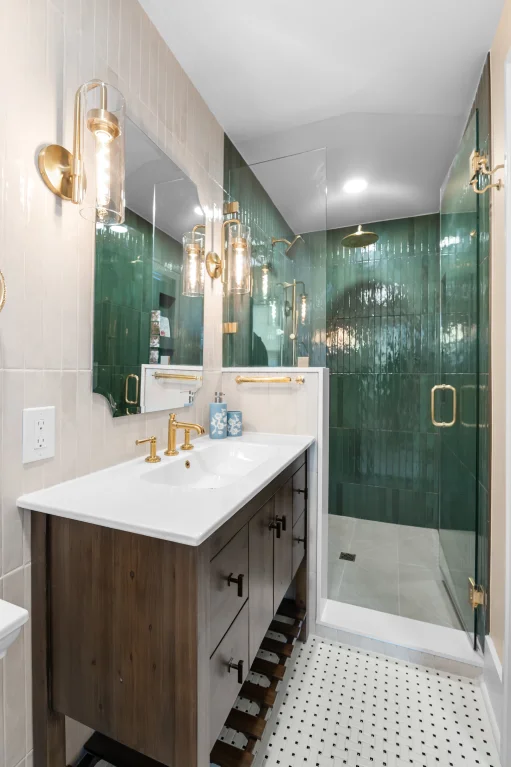
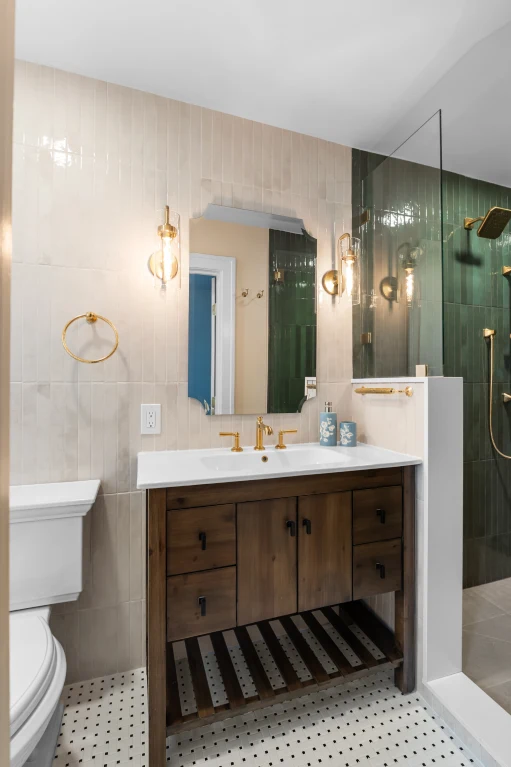
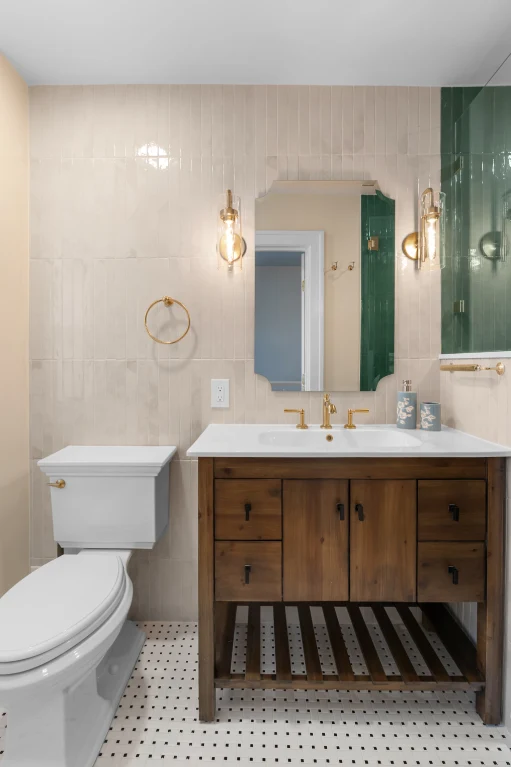
Bathroom floor — Basketweave Matte White with Black Porcelain Mosaic. Period-appropriate for a West Highland home, and small-format enough to distribute the heated floor’s warmth evenly.
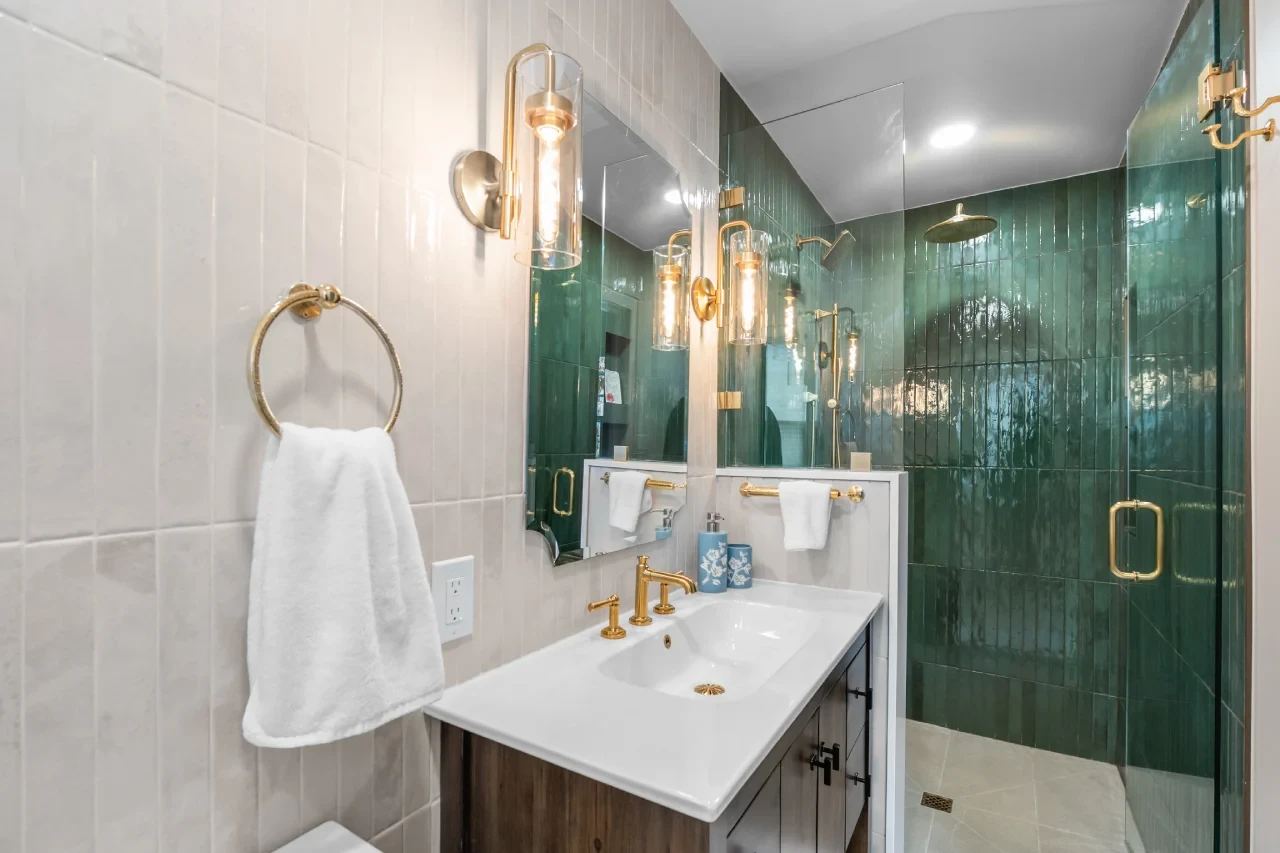
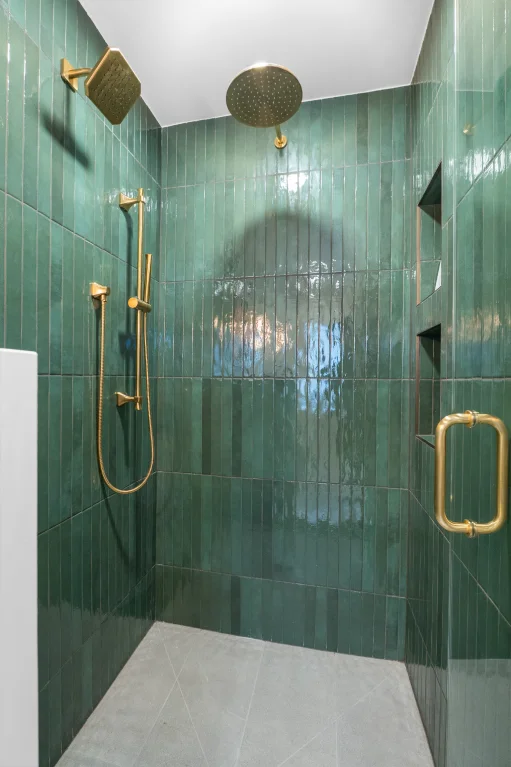
Shower walls — 2″x10″ Forest Porcelain Wall Tile, stacked vertically. The deep green glazed feature wall that anchors the bathroom.
Shower pan — Naturalz Matte Ash Porcelain, 12″x24″. Large-format for fewer grout lines underfoot.
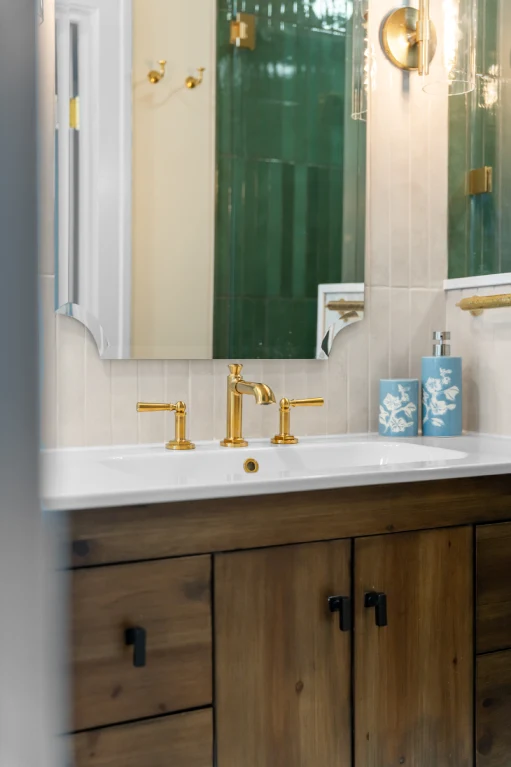
Bathroom walls (wainscot height) — 2″x10″ Milk Porcelain Wall Tile, stacked vertically. Same shape and orientation as the shower tile in a soft cream, carrying the visual rhythm out of the shower and into the rest of the room.
Lighting
Two Kohler Purist 1 brass wall sconces flank the vanity mirror for task lighting, with a single recessed can light in the ceiling for overhead fill.
Good lighting matters in a small bathroom with limited space — the mix of vertical sconce light and overhead can light helps the space feel brighter and avoids the cast shadows a single fixture creates.
Electrical & Heated Floor
Full bathrooms require at least one GFCI-protected outlet near wet areas, and the electrical work in this bath included new dedicated circuits for the lights, the exhaust fan, and the in-floor heating.
The heated floor uses the Schluter DITRA-HEAT system — an electric heating cable embedded in the uncoupling membrane under the floor tile, governed by a wall-mounted thermostat.
Radiant electric mats under tile are particularly well-matched to heated floors in Colorado homes, where bathroom floors can sit twenty degrees cooler than the adjacent rooms in winter.
HVAC / Ventilation
We installed a Panasonic ducted ceiling exhaust fan, hard-vented through the roof.
The IRC sizing standard is at least 1 CFM per square foot of bathroom floor area, with the fan upsized when multiple wet fixtures are in play.
Proper ventilation does more than vent steam — moisture has to leave the room rather than settle into the wall and joist cavities, which is where mold and mildew growth tends to start in any wet environment, especially in older homes.
More on the venting path in our guide to bathroom exhaust fan venting.
Plumbing
The home’s original galvanized water supply lines were removed and replaced with PEX.
Galvanized supply lines corrode internally over time, restricting flow and discoloring the water — a near-universal issue in homes built during West Highland’s original development period.
The new pipes flex with thermal change and tolerate Denver’s freeze-thaw cycles better than rigid copper, with fewer joints to fail.
Drain-waste-vent sizing followed code — the new drain lines were sized as:
2″ PVC for the shower and vanity drains
3″ PVC for the toilet branch
Fixtures
Plumbing fixtures are brass-finish across the board, mixing premium materials from Kohler and Delta:
Vanity faucet — Kohler Purist widespread, brass
Shower system — Delta brass, with a ceiling-mounted rainhead, a wall-mounted fixed showerhead, and a handheld on a slide bar
Toilet — Kohler, white porcelain
Accessories — Brass towel ring, brass shower glass door pulls
Frequently Asked Questions
Do you need a permit to convert a powder room to a full bath in Denver?
Yes. The City and County of Denver requires building, plumbing, electrical, and mechanical permits for any project that adds or relocates plumbing fixtures, runs new circuits, or installs new ventilation. Trade permits are typically pulled by the licensed contractor on the job, and the work must meet Denver’s residential building codes throughout the project. Inspections occur at framing, plumbing rough-in, electrical rough-in, and final. Unpermitted bathroom work can be red-tagged by the city and is one of the most common findings flagged during home-sale inspections.
How small can a full bathroom be by code?
The IRC sets minimum clearances rather than minimum room sizes. A toilet needs at least 15 inches from its center to any sidewall or adjacent fixture, plus 21 inches of clear floor space in front. A walk-in shower stall must measure at least 30″×30″ of clear interior space. In practice, a full bathroom can fit in roughly 30–35 square feet when laid out efficiently — though most new construction targets 40+ square feet for comfort.
Why is a walk-in shower a better fit than a bathtub in most powder room conversions?
A standard tub is 60 inches long and 30 inches wide — about 12.5 square feet of floor footprint. A walk-in shower can fit in a 30″×30″ footprint, roughly half the floor area. In a tight conversion built on the combined footprint of a powder room and an adjacent closet, the shower is usually the only option that leaves more space for the vanity, toilet, and circulation. Walk-in showers also offer better accessibility and a more modern look — more on layout possibilities in our guide to doorless walk-in shower ideas.
How long does a powder-room-to-full-bath conversion take?
A typical conversion runs about 4–6 weeks from demo to final inspection, depending on permit turnaround, material lead times, the depth of the renovation scope, and the condition of the existing plumbing and electrical. Projects that include a galvanized-to-PEX replacement — like this West Highland build — sit at the longer end, because the entire supply branch back to the main has to come out and be re-run.
How much does a powder-room-to-full-bath conversion cost?
The overall cost of a powder-room-to-full-bath conversion typically runs between $5,000 and $25,000, with the final number driven by the scope of plumbing rework, the finish level, and any structural changes. Moving a non-load-bearing partition wall (like the one between this project’s powder room and adjacent closet) typically costs $2,000–$5,000 on its own, and a comprehensive shower waterproofing assembly like Schluter KERDI plus RedGard adds another $800–$2,000 to the project total. Projects requiring a full galvanized-to-PEX supply replacement, like this West Highland build, sit at the higher end of the range.
Will an existing water heater handle a second full bathroom?
Often, yes — but it’s worth checking before the conversion starts. Adding a full bath means the water heater has to supply hot water for additional fixtures simultaneously, and an undersized tank can leave the second shower running lukewarm during peak morning use. For most powder-room-to-full-bath conversions a modern 40- or 50-gallon tank can absorb the additional load; older or smaller units may need a replacement tank or a tankless upgrade as part of the project scope.
Does adding a full bathroom increase home value?
Yes — particularly in Denver’s older neighborhoods, where many of the original West Highland and Highland bungalows were built with only one full bathroom. Converting an existing half bath into a second full bath is one of the highest-impact bathroom remodels for both resale value and day-to-day function. In real estate listing terms the property moves from 1.5 baths to 2 baths — a real but modest jump in MLS bathroom-count filters — but in daily function the jump is much bigger, since two showers can run simultaneously instead of one. For buyers house hunting in this market, the second shower often matters more than the listing arithmetic.
Is porcelain or ceramic tile better for a bathroom?
Both work, but porcelain is the better choice for shower floors, shower walls, and other wet environments around the bathroom. Porcelain is denser, has a water absorption rate under 0.5% (versus 3–7% for ceramic), and is more durable underfoot. This project used porcelain throughout — floor, shower walls, shower pan, and wall wainscot. See our porcelain vs ceramic tile comparison for the full breakdown.
Related Project & Service Area
For another conversion that started with an underused space and ended in a full bathroom, see the closet-to-bath spa-inspired transformation — a similar reclaim-the-footprint approach, in a different style direction.
Verified Builders is a licensed Denver general contractor based at 1660 Lafayette Street, Unit 4, Denver, CO 80218, serving West Highland and the adjacent Sloan’s Lake, Berkeley, Sunnyside, and Highland neighborhoods.
Call (720) 788-2230 to discuss a similar conversion.